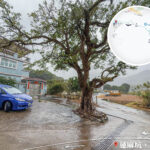
🏡【Lin Ma Hang (蓮麻坑)】 is located around Robin’s Nest in the North District of the New Territories. Previously a restricted border area, it has successfully preserved a relatively untouched natural environment. Nested within surrounding hills, the village backs onto Robin’s Nest and faces the Sha Tau Kok Sea. It is built right along the hillside, showcasing a classic Hakka settlement layout. Because it was sealed off from the public for decades, Lin Ma Hang still retains a quiet, rustic charm that stands out in sharp contrast to the bustling city center.
📌 Quick Facts
Category Details 📍 Location Situated between Sha Tau Kok 營 and Ta Kwu Ling 🏞️, sitting right up against the border along the Shenzhen River 🌊. ⛰️ Terrain A river valley landscape 🌄 surrounded by peaks like Robin’s Nest 🌳, A Kung Ting 🏔️, Yi Tung ⛰️, and Sam Tung ⛰️. Backed by the Robin’s Nest mountain range, the village is built along the slopes 🏡, with the valley terrain feeding local farmlands 🌾 and clear water sources 💧. 🚧 Restricted Area Background Designated as part of the Frontier Closed Area 🔒 after 1949, requiring a “Closed Area Permit” 📄 for entry. It was partially opened in 2016, and from 2025 onwards, visitors can easily take a minibus 🚌 straight into Lin Ma Hang Village. — Lin Ma Hang once boomed due to lead mining, leaving behind several mine caves that have now become vital bat habitats carrying unique scientific value. The most iconic landmark in the village is Ip Ting-sz’s Former Residence. Built in 1908 and modeled after Sun Yat-sen’s former home, it stands as a testament to overseas Chinese and revolutionary history. Along the way, you can also spot military pillboxes, World War II relics, and a MacIntosh Fort—allowing this border valley to carry both rich ecological wonders and cultural stories, serving as a unique gateway to explore Hong Kong’s borderland heritage. —
🏞️ Natural Ecology
Category Details ⛰️ Mountain Peaks Robin’s Nest: The highest peak in northeast Hong Kong, rising about 492 meters high and serving up bird’s-eye views over the Sha Tau Kok coastline 🌊. ⛏️ Mine Caves Lin Ma Hang Lead Mine Cave: The largest lead mine ruins in Hong Kong 🏭. Today, it acts as a crucial bat breeding site 🦇 and is designated as a Site of Special Scientific Interest (SSSI) 📜. It has been revitalized into an “open-air museum,” featuring “Mine Cave No. 6” (nicknamed “The Grand Hall” 🏛️), which can be freely visited outside. 🌿 Ecological Hotspots Surveys by the Kadoorie Farm and Botanic Garden show that the Lin Ma Hang feng shui woods and secondary forests shelter various rare species:
- 🐦 Orange-headed Ground Thrush
- 🦌 Muntjac Deer
- 🦝 Masked Palm Civet
- 🌱 Gymnosphaera metteniana, a rare tree fern species recorded for the first time in Hong Kong.
💧 Rivers Lin Ma Hang River: Flowing into the upper reaches of the Shenzhen River, its waters are crystal clear 💦 and teeming with thriving freshwater fish populations 🐟. 🌸 Flora Wild red azaleas burst into full bloom during spring 🌺, splashing vibrant colors across the entire valley. —
🏯 Culture & History
- Lin Ma Hang Village: Home to fewer than a hundred residents today (down from over a thousand in its heyday), this predominantly Hakka village is dominated by the “Ip” (Yip) clan and perfectly preserves its traditional layout.
- Ip Ting-sz’s Former Residence: Built in 1908 and modeled after Sun Yat-sen’s ancestral home in Cuiheng Village, this historical gem stands as a Declared Monument witnessing overseas Chinese support for the revolution.
- Yip Clan Ancestral Hall: A grand structural showcase of ancestral heritage and family lineage.
- Military Relics: WWII-era machine gun pillboxes, observation posts, wells, and old barracks are scattered along the trails. You can also visit a MacIntosh Fort—a Grade 2 Historic Building that reflects the intense border defense history of yesteryear.
—
⚒️ Mining & Wartime Resistance
Theme Details ⚒️ Mining Industry British companies mined lead here in the 1930s. During WWII, Japanese forces took over the mining operations to fuel their military supplies. ✊ Anti-Japanese Resistance In 1943, three local village youths attempted to blow up the mines to halt the Japanese military supply line, but they were caught and tortured by the military police. Later, village youth Ip Wai-li joined the Dongjiang Guerrilla Force and successfully led a squad to blow up the mine works in 1944, creating a legendary local resistance tale. —
🚶♂️ Transport & Hiking Tips
- Transport: Take Green Minibus 59K from Sheung Shui MTR Station straight to Lin Ma Hang Village. The ride takes about 30 minutes and costs around HKD 9.9.
- Hiking Difficulty: Requires a vertical climb of about 200 meters and taking on 900 steps. The trek to the mine caves takes around 45 minutes and is best suited for experienced hikers.
- Things to Note:
- There are absolutely no stores or restaurants along the entire route, so packing your own food and water is a must.
- Minibus schedules are quite sparse, running roughly every 30 minutes.
- The former border area is fully open, meaning you no longer need to apply for a Closed Area Permit.
—
🌄 Robin’s Nest & Lin Ma Hang Day Trip Itinerary
🕘 Morning: Setting Off & Peak Climb
- 09:00: Head out from Sheung Shui MTR Station and catch Green Minibus 59K to Lin Ma Hang Village.
- 09:30: Arrive at the village entrance, do a quick gear check, and hydrate.
- 09:45: Kick off the hike, following the trail to climb up toward the summit of Robin’s Nest.
- The Walk: Covers a 200-meter elevation gain and features around 900 stone steps.
- Highlights: Enjoy open views of the Shenzhen River and Sha Tau Kok along the climb.
—
🕛 Midday: Peak Panorama & Eco Exploration
- 12:00: Reach the summit of Robin’s Nest Peak and enjoy your packed lunch.
- The View: Offers sweeping views over the Shenzhen city skyline and the rolling mountain ranges of the northern New Territories.
- Wildlife: Keep your eyes peeled for local wildlife like the Orange-headed Ground Thrush or Muntjac Deer.
—
局 Afternoon: Mine Cave Exploration
- 13:30: Head back down along the trail to the Lin Ma Hang Lead Mine Cave.
- Highlights: Take in Hong Kong’s largest lead mine ruins, which are now a protected SSSI bat habitat.
- Safety Note: The deep interior sections of the mine shafts are sealed for safety; visitors can explore and view the history from the designated outer areas.
- 14:30: Dive into the history signs to learn all about the WWII Japanese mining operations and the brave anti-Japanese resistance stories of the local villagers.
—
🕒 Late Afternoon: Heritage & Culture Walk
- 15:00: Visit Ip Ting-sz’s Former Residence, built in 1908 to match Sun Yat-sen’s ancestral home—now a stunning Declared Monument.
- 15:30: Walk over to the Yip Clan Ancestral Hall to get a taste of traditional Hakka clan culture.
- 16:00: Head up toward the MacIntosh Fort to learn more about Hong Kong’s historical border defense system.
—
🕔 Evening: Head Home
- 17:00: Hop back on the minibus at Lin Ma Hang Village to return to Sheung Shui.
- 17:30: Wrap up your day trip.
—
🎒 Day Trip Tips
Item Details 🧗 Gear Sturdy hiking shoes, a hat, sun protection, and plenty of food and water. ⚠️ Safety Do not venture past safety barriers into the deep mine shafts; watch your step as mountain paths can be slippery. 🤝 Respect Culture The village is an active residential area. Please keep your volume down and respect the privacy of local residents while exploring.