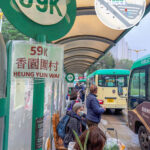
🚐 【Minibuses】(Public Light Buses) are an incredibly agile form of transport that penetrates deep into local communities within Hong Kong’s bustling urban transit network. Separated into 🟥 Red Minibuses (RMBs) and 🟩 Green Minibuses (GMBs), they carry over a million passenger trips daily, serving as a vital supplement to the railways and franchised buses. Renowned for being fast, flexible, and capable of penetrating deep into residential areas, minibuses can navigate narrow streets that are inaccessible to large buses, ensuring residents maintain an efficient way of getting around the hectic city.
🚐 Basic Specifications of Minibuses
Item Data / Description 🪑 Seating Limit Maximum 19 seats 🚍 Fleet Size Cap 4,350 vehicles (Fixed since 1976) 👥 Daily Ridership (Sept 2025) Approx. 1,464,200 passenger trips 🟩 Green Minibuses (GMBs) 1,329,100 passenger trips 🟥 Red Minibuses (RMBs) 135,100 passenger trips 💳 Payment Methods Predominantly cash-based; some accept Octopus cards, with e-payment options being progressively introduced in recent years ⚡ New Energy Development Electric Minibus Pilot Scheme is underway to promote zero-emission transit —
🟥 Red Minibuses (RMBs)
- Operation Mode:
- Routes, schedules, and fares are non-fixed and purely market-driven.
- Flexible rerouting; drivers can take alternative routes to bypass traffic jams.
- Service Area:
- Allowed to operate across most urban areas, such as Tsim Sha Tsui, Admiralty, and West Kowloon.
- Prohibited from entering designated new towns, such as Sha Tin, Tuen Mun, and Tseung Kwan O.
- Current Status: Only 707 vehicles remaining in 2025, showing a gradual decline.
—
🟩 Green Minibuses (GMBs)
- Operation Mode:
- Fixed routes, schedules, and fares regulated by the Government.
- The entire fleet is equipped with positioning devices, allowing passengers to check real-time arrival information via the “HKeMobility” App.
- Pilot trials of new energy electric minibuses equipped with fast-charging support have been rolling out since 2022 to promote zero emissions.
- Service Area:
- Territory-wide coverage spanning Hong Kong Island, Kowloon, and the New Territories.
- In 2025, a total of 3,357 vehicles operated across 361 main routes (67 on HK Island, 83 in Kowloon, 211 in the New Territories).
- Current Status: Serving as the backbone of the minibus fleet, with 3,357 vehicles running 361 routes and drawing a daily ridership of over 1.3 million in 2025.
—
🚐 Origin & History
Decade / Time Events & Key Features 🚌 1960s Due to a population boom and a shortage of buses and trains, illegal unlicensed hire cars emerged, locally dubbed “Pak Pai Chai” or “9-seaters”. ⚠️ 1967 1967 Riots Bus drivers went on strike, paralyzing public transport; “Pak Pai Chai” stepped up to become the primary mode of transit. 📑 1969 The Government officially legalised the vehicles and began regulating them through licensing, capping capacity at 14 passengers per vehicle. 🟩 1974 Green Minibuses (GMBs) made their debut, introducing scheduled services on fixed routes. ➕ 1988 Seating capacity was increased from 14 to 16, and later progressively upgraded to 19 seats. 🔋 Current Status (up to 2027) The Government maintains strict fleet size controls while actively promoting new energy electric minibuses. —
📊 Comparison Table
Category Red Minibuses (RMBs) 🟥 Green Minibuses (GMBs) 🟩 Route Non-fixed; dynamically adjusted Fixed routes, schedules, and fares Management Individual owner-operators / small firms Regulated by the Government Payment Mainly cash; limited Octopus acceptance Octopus and e-payments are widely adopted Vehicle Count 707 vehicles 3,357 vehicles Key Features Fast and flexible; penetrates older urban districts Stable and reliable; extensive coverage —
🌟 Cultural Identity of Minibuses
- The “Yau Lok” Culture: Shouting “Yau Lok” (dropping off) when approaching a destination is a unique linguistic quirk of Hong Kong transit.
- The Need for Speed: Red minibuses are often colloquially dubbed “desperado minibuses” due to their aggressive and rapid driving style, which keeps them agile but sparks safety debates.
- Community Connection: Green minibuses weave deep into various neighborhoods, acting as an indispensable commuter tool for everyday residents.
- Visual Identity: Red tops vs. green tops; the vibrant, contrasting roof colours form an iconic slice of Hong Kong’s streetscape.