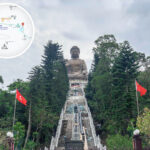
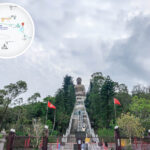
🧘♂️ 【Tian Tan Buddha / The Big Buddha (天壇大佛)】 is the world’s tallest outdoor bronze seated Buddha statue. It is situated atop Muk Yue Peak in Ngong Ping on Lantau Island , Hong Kong, at an altitude of 520 meters. Commanded and planned by Po Lin Monastery , the project took 12 years to complete and was officially inaugurated in 1993. The Buddha statue itself stands 26.4 meters tall, reaching a total height of approximately 34 meters when including the lotus seat and the multi-level base platform. Weighing 250 metric tons, it is constructed from 207 bronze pieces. The facial expression was inspired by the Vairocana Buddha of the Longmen Grottoes, while the drapery folds of the robes draw from the Shakyamuni Buddha image in Dunhuang Grottoes, beautifully capturing the essence of Sui and Tang Dynasty Buddhist art. Facing south toward Beijing, the Buddha’s right hand is raised in the “Abhaya Mudra” (fearlessness), while the left hand rests on the lap in the “Varada Mudra” (giving), symbolizing the deliverance of all sentient beings and the bestowing of blessings. The base platform design is inspired by the Temple of Heaven in Beijing and houses three exhibition halls: the Hall of Merit (功德堂), the Hall of Dharmadhatu (法界堂), and the Hall of Remembrance (紀念堂), where the sacred Relic of the Buddha (真身舍利) and various Buddhist cultural artifacts are enshrined. —
📍 General Information
Item Details 🗿 Name Tian Tan Buddha / The Big Buddha (天壇大佛) 📍 Location Muk Yue Peak, Ngong Ping , Lantau Island , Hong Kong (approx. 520 meters above sea level) 🗺 Coordinates 22°15′15″N, 113°54′19″E 🏛 Type Outdoor bronze Shakyamuni Buddha statue, monument, sculpture, world-renowned tourist destination 🧱 Materials Tin-bronze alloy (originally conceptualized as reinforced concrete, later changed to bronze) 📐 Dimensions Statue height: 26.4 meters; total height including lotus seat and base: approx. 34 meters ⚖ Weight Approx. 250 metric tons 🧩 Bronze Pieces A total of 207 bronze plates (165 for the Buddha body, 36 for the lotus seat, 6 for the cloud canopy) 🪜 Number of Steps 268 stone steps 🏗 Construction Planning commenced in 1981; officially consecrated on December 29, 1993 🧭 Base Footprint Approx. 6,567 square meters 🕰 Opening Hours Open daily until 17:30 🧭 Access Accessible via the Ngong Ping 360 cable car, public bus, or Lantau taxi 🧘♂️ Cultural Role Symbolizes Hong Kong’s stability and prosperity, national peace, and world harmony; seamlessly blends ancient Buddhist statuary art with modern engineering technology 🏛 Design Sources Facial features modeled after the Vairocana Buddha of the Longmen Grottoes; drapery and head ornaments draw from Cave 360 of the Dunhuang Grottoes 🔗 Official Website Po Lin Monastery Official Website —
🕒 Opening Hours
- Tian Tan Buddha / The Big Buddha : 10:30–17:30 daily
- Po Lin Monastery : 09:00–18:00 daily
- Wisdom Path : Open 24 hours all year round
- Ngong Ping Village : Weekdays 10:00–18:00; Weekends & Public Holidays 09:00–18:30
— — The Tian Tan Buddha / The Big Buddha is not only an iconic landmark of Hong Kong but also an architectural masterpiece combining modern technology with traditional craftsmanship, earning a place among “Hong Kong’s Ten Outstanding Engineering Projects.” Visitors can ascend the 268 stone steps to reach the platform base to enjoy panoramic vistas of Lantau Island , or arrive via the Ngong Ping 360 cable car while taking in sweeping views of the mountains and sea. Surrounding points of interest include Po Lin Monastery , the Wisdom Path , and Ngong Ping Village , culminating in a unique journey that integrates religion, culture, and nature. Between 2020 and 2021, the Big Buddha underwent large-scale maintenance to repair its protective coating and optimize the platform facilities, continuing to draw global pilgrims and sightseers alike. —
🚠 Transportation Methods
Mode of Transit Travel Time Estimated Fares Remarks Ngong Ping 360 Cable Car (昂坪360) Approx. 25 minutes Approx. HK$100–290 Magnificent scenic aerial views New Lantao Bus No. 23 Approx. 50 minutes Weekdays: HK$18.7
Sundays & Holidays: HK$31Winding mountain roads Lantau Blue Taxi Approx. 40 minutes Approx. HK$200–250 Higher travel costs —
🧘♂️ Conception & Naming Origins
- The Core Concept: In 1973, venerable monks from Po Lin Monastery (寶蓮禪寺) visited massive Buddha statues in Japan and Taiwan, inspiring a vision to construct a monumental Buddha in Hong Kong to serve as a symbol of stability, peace, and spiritual guidance.
- Behind the Name: The name “Tian Tan Buddha” was bestowed because its three-tiered base platform design replicates the architectural plan of the Hall of Prayer for Good Harvests at the Temple of Heaven (Tian Tan) in Beijing, honoring the Buddha as the “God of Gods.”
- Land Allocation: In 1974, the Hong Kong government officially granted the site on Muk Yue Peak for the construction of the monument.
- Project Planning: The dedicated construction committee was formed in 1981 to spearhead the structural design and engineering implementation.
- Grand Consecration: Following 12 years of meticulous work, the opening ceremony was celebrated on December 29, 1993.
—
🏗 Engineering Highlights
- The casting, fabrication, and final structural assembly were undertaken by the Nanjing Morning Light Machinery Factory of China Aerospace.
- The outer structure comprises 207 thick bronze plates fitted with an ultra-strict installation tolerance of less than 3 millimeters, showcasing outstanding precision.
- To withstand typhoons and severe coastal weather, rigorous wind tunnel tests were conducted, and structural designs incorporated satellite and rocket engineering technologies.
—
🏗️ Technical Breakthroughs & Construction Timeline
Phase Details Artistic Design The scaling models were designed by Ms. Hou Jinhui from the Guangzhou Academy of Fine Arts. Lofting Precision Advanced computerized coordinate lofting techniques were employed to attain flawless structural alignment. Foundry Casting Managed by the Nanjing Morning Light Machinery Factory, the main structure was meticulously cast into 202 distinct bronze outer sections. Logistics Challenge Components were shipped by sea to Hong Kong, then transported up the steep mountain tracks using specialized heavy-duty cranes. Final Capstone The installation of the final bronze wall piece was completed in 1989, marking the completion of the main statue structure. —
🙏 Artistic & Iconographic Characteristics
- Buddha Manifestation: Shakyamuni Buddha (釋迦牟尼佛)
- Iconographic Blueprint: Styled strictly in adherence to the “32 Major Marks of a Buddha” (如來三十二相) recorded in Buddhist sutras.
- Facial Inspiration: Modeled after the majestic serenity of the Vairocana Buddha at the Longmen Grottoes.
- Robes & Drapery: Modeled after the flowing vestments depicted in Cave 360 of the Dunhuang Grottoes.
- Hand Gestures (Mudras): The right hand displays the Abhaya Mudra, symbolizing the dispelling of fear; the left hand shows the Varada Mudra, symbolizing compassion, benevolence, and blessing.
- Chest Emblem: Features the engraved Sauwastika (卍), representing the accumulation of countless noble virtues.
- Lotus Base: A throne of pure lotus petals symbolizing absolute spiritual purity, untainted by the mundane world.
—
⚖️ Aesthetic Form & Spiritual Symbolism
Aesthetic Feature Spiritual Symbolism Full-moon countenance with a gentle smile Represents the Buddha’s perfect merit and wisdom, bringing joy and comfort to all living beings. Cranial bump and spiral curls (Ushnisha) Symbolizes supreme, boundless spiritual wisdom. Blue lotus-shaped eyes Signifies looking upon all sentient beings with complete compassion. Abhaya Mudra (Right hand raised) Symbolizes liberating suffering souls from fear and worldly afflictions. Varada Mudra (Left hand open) Represents boundless mercy, answering prayers, and bestowing blessings. Swastika emblem (卍) on the chest Represents the ultimate solemnity and perfection of all virtues. Full Lotus Position (Padmasana) Indicates absolute serenity and dedication to the salvation of all beings. —
🏛️ Interior Layout of the Base
Level Functions & Key Exhibits Hall of Merit Enshrines Ksitigarbha Bodhisattva (地藏王菩薩) alongside dynamic oil paintings depicting the Buddha’s life teachings. Hall of Dharmadhatu Exhibits classic Buddhist calligraphy, religious paintings, and a grand woodcarving representing the Avatamsaka Assembly. Hall of Remembrance Enshrines the highly revered sacred Relic of the Buddha, which was formally welcomed to Hong Kong from Sri Lanka. —
💃 The Offering of the Six Devas
Facing the Big Buddha are six smaller kneeling bronze statues known as “The Offering of the Six Devas.” They are depicted in graceful dancing poses offering flowers, incense, a lamp, ointment, fruit, and music to the Buddha. These offerings symbolize the “Six Perfections” (Paramitas) of Buddhism: Generosity, Morality, Patience, Zeal, Meditation, and Wisdom.
—
📸 Recommended Surrounding Attractions
Attraction Name Highlights & Descriptions Po Lin Monastery Visitors can sample traditional Buddhist vegetarian cuisine and tour the grand Main Shrine Hall and the Grand Hall of Ten Thousand Buddhas. Wisdom Path An outdoor installation composed of 38 upright wooden pillars inscribed with the Heart Sutra verses, arranged in an infinity symbol (∞) configuration. Ngong Ping Village A culturally themed retail village packed with souvenir shops, local street snacks, and interactive photo spots. The Offering Devas Six exquisite bronze sculptures surrounding the steps, representing the six perfections essential to spiritual enlightenment. —