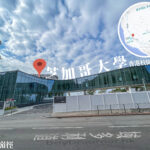
🎓 【The University of Chicago Francis and Rose Yuen Campus in Hong Kong (芝加哥大學 香港校園)】located at 168 Victoria Road, Mount Davis on Hong Kong Island, is an international campus that seamlessly blends heritage conservation with modern academic functions. The site’s predecessor is a building complex rich in historical layers, originally serving as the Jubilee Battery during World War II. It was later used as a temporary refugee camp, as well as a mess hall and quarters for Royal Engineers of the British Army. In 1961, it became the Victoria Road Detention Centre under the Special Branch of the Hong Kong Police Force (commonly known as the 『White House』) and was left vacant for a period after the handover of sovereignty. In 2013, The University of Chicago was granted the site by the government at a nominal land premium and spent USD 75 million (approximately HKD 586 million) on its revitalization. Officially opened in 2018, it now stands as a prime example of coexistence between Grade 3 historic buildings and new architectural design. —
🏛️ Campus Fast Facts
📌 Category 📚 Information Details 🏫 Campus Name The University of Chicago Francis and Rose Yuen Campus in Hong Kong 📍 Location 168 Victoria Road, Mount Davis, Hong Kong 🗺️ District Mount Davis, located in the western part of Hong Kong Island 🏗️ Architectural Design Designed by Revery Architecture (formerly Bing Thom Architects), integrating historical heritage conservation elements 🏛️ Campus Highlights Revitalized on the original site of the 『White House』 historic complex, featuring a heritage courtyard exhibits, guided tours, and a viewing deck 📐 Gross Floor Area Approx. 53,000 sq. ft. 🎓 Opening Year Officially opened in 2018, with further expansion in 2025 💰 Construction Cost Approx. USD 75 million (approx. HKD 586 million) 📖 Educational Programs Executive MBA (EMBA) program, academic research center, public lectures, study abroad programs, etc. 🌏 International Collaboration Partnering with institutions like Tsinghua University to foster East-West cultural exchange and academic interaction — The campus design was masterplanned by international architectural firm Revery Architecture (formerly Bing Thom Architects) with the 『Treehouse of Knowledge』 as its core concept. Built along the hillside using a ribbon-like suspended structure, it minimizes disturbance to the natural terrain and historical remains. The campus preserves the original detention centre’s white exterior walls, the weathered traces of detention cells, and the remnants of the battery. It also features a heritage courtyard exhibition that tells the story of the site’s transformation across six historical periods (including the Jubilee Battery, refugee shelters, and the police detention centre). The new building provides modern learning spaces such as classrooms, a library, and group study rooms, primarily serving the Executive MBA (EMBA) program of the Booth School of Business. —
🏛️ Historical Background & Site Selection
- Location:168 Victoria Road, Mount Davis, nestled in the western hills of Hong Kong Island, overlooking the South China Sea
- Predecessor:The site was originally the 『White House』, namely the former Victoria Road Detention Centre, which served as a detention facility for political prisoners, a refugee camp, and a British military defensive structure
- Historical Layers:The heritage site where the campus stands has witnessed six historical periods, including the WWII Jubilee Battery, post-war refugee camps, and Royal Hong Kong Police facilities
—
🏗️ Architectural Design & Heritage Conservation Spirit
- Design Firm:Spearheaded by Canadian architectural firm Revery Architecture (formerly known as Bing Thom Architects)
- Revitalizing the historic architecture while preserving the original appearance of the 『White House』, including:
- Detention interrogation/visiting rooms
- Gun emplacement positions manned by the Royal Garrison Artillery
- The Jubilee Battery remnants
- Design Philosophy:
- Emphasizing 『minimal intervention』 to the original buildings on site
- Preserving original structures like visiting rooms and gun ports to serve as heritage exhibits
- Minimizing the installation of external air-conditioning units to maintain aesthetic integrity
- High engineering difficulty:
- The campus is built according to the contours of the hill; the piling works took a full year with around 200 foundation piles driven
- Balancing foundation stability with historic building conservation
- Reducing external air-conditioning installations to preserve the heritage facade
- The campus spans a gross floor area of 53,000 sq. ft., equipped with lecture theatres, study rooms, a library, and a viewing deck
—
🚇 Transportation Information
Starting Point Transport Method & Route 🚉 MTR Kennedy Town Station Take green minibus 58 or 58M and get off at the Mount Davis Path stop 🏙️ The Landmark, Central Take bus route 1 and get off at the Mount Davis Path stop 🚶♂️ Walking Suggestion Walk along Mount Davis Path for about 10 minutes to reach the campus entrance —
🌅 Check-in Spots & Cultural Activities
- The campus exterior blends history with modernity, making it a hotspot for catching sunsets at Mount Davis
- Regularly hosts concerts, cultural exhibitions, and guided heritage tours
- The heritage courtyard exhibits showcase the evolution of Mount Davis across six historical periods
- 📸 Pro-tip: Head there during dusk to capture stunning sunset shots and beautiful campus silhouettes
- 🏛️ Online registration is required for the heritage courtyard exhibits, and guided tour slots are limited
- 🧢 As the campus is located on high terrain, wearing comfortable shoes and bringing sun protection is highly recommended
- 📖 Feel free to attend public lectures and workshops organized by the university to experience UChicago’s academic vibe
—
🧠 Academic Mission & Research Directions
The University of Chicago Hong Kong Campus is not just a teaching base, but also a hub for academic exchange in Asia:
- Three Core Research Themes:
- Business, Economics, Law, and Policy
- Culture, Society, Religion, and the Arts
- Science, Energy, Medicine, and Public Health
- Research Institutions:
- The Becker Friedman Institute (BFI) China
- Signed a Memorandum of Understanding (MOU) with Tsinghua University to promote joint academic exchange between China and the US
- Academic Activities:
- Hosting conferences, public lectures, and workshops
- Supporting 122 research and teaching projects, covering areas such as economics, psychology, and linguistics
— As The University of Chicago’s first campus in Asia, its function goes beyond traditional teaching, striving to become an academic hub connecting China and the globe. The campus regularly hosts public guided tours, opening up its heritage trails and Jubilee Battery remnants, and collaborates on research with institutions like Tsinghua University, embodying the fusion of historical legacy and an international academic mission. In terms of transport, visitors can arrive via bus routes like 5B and 971, but please note that parking and commercial filming are strictly prohibited on campus. —
🎓 Academic & Educational Programs
1. Chicago Booth Executive MBA (EMBA) Program
- A 21-month program with tuition fees around HKD 1.35 million
- Includes short-term study periods and residency at the Chicago and London campuses
- Admits around 75 students annually, coming from Hong Kong, Mainland China, Singapore, Japan, and beyond
2. Executive Non-Degree Programs
- Tailored for local professionals to enhance their leadership and management skills
3. Becker Friedman Institute (BFI) China
- The Asian branch of the 『Becker Friedman Institute』
- Collaborates with Tsinghua University to conduct research on Chinese economic issues
4. Study Abroad Programs
- Undergraduate students from The University of Chicago can take short-term courses at the Hong Kong campus
- Courses span fields like economics, global studies, and more
—
🧭 Campus Mission & Positioning
- As the first permanent campus of The University of Chicago in Asia, its goals include:
- Driving international academic collaboration
- Expanding the global educational network
- Serving as a bridge for cultural exchange between East and West
- The campus upholds the core values of The University of Chicago:
- Free and open debate
- Interdisciplinary exchange
- Rigorous research
—
🖼️ Campus Facilities & Cultural Exploration
- Gross Floor Area:Approx. 53,000 sq. ft.
- Key Facilities:
- Lecture theatres, group study rooms, and a library
- The Mount Davis viewing deck and heritage courtyard exhibits
- The Hong Kong Jockey Club University of Chicago Academic Complex and Social Innovation Program supported by the HKJC
- Guided Tours & Opening Arrangements:
- The heritage courtyard exhibits are open six days a week, with online reservations required for four of those days
- Guided tours in Cantonese and English are available on Fridays and Sundays
—
🌐 Social Impact & Vision
- Bridge Between East and West:With Hong Kong being the place where East meets West, the campus facilitates local research on pressing global issues
- Platform for Innovation and Research:Aligning with the Hong Kong government’s I&T policies, the campus acts as a catalyst for local R&D and international collaboration
- Public Engagement:The campus does not just serve its students; it is also open to the general public, becoming a valuable resource for culture and education
—
📌 Fun Facts Trivia
- In 2013, The University of Chicago was granted the 『White House』 site at a nominal land premium of HKD 1,000
- The campus was named the 『Francis and Rose Yuen Campus』 in recognition of the generous donation by alumnus Francis Yuen and his wife Rose
—
🌏 Impact on Hong Kong
- Enhancing the internationalization and diversity of Hong Kong’s higher education sector
- Becoming a central hub for academic research and innovation in Asia
- Fostering collaboration and exchange between local and global scholars
- Supporting Hong Kong’s transformation from a financial city into an international innovation and technology hub
—
📌 Fun Facts Trivia
- In 2013, The University of Chicago was granted the 『White House』 site at a nominal land premium of HKD 1,000
- The campus was named the 『Francis and Rose Yuen Campus』 in recognition of the generous donation by alumnus Francis Yuen and his wife Rose
—